
How to Start Learning AI: A Beginner Roadmap
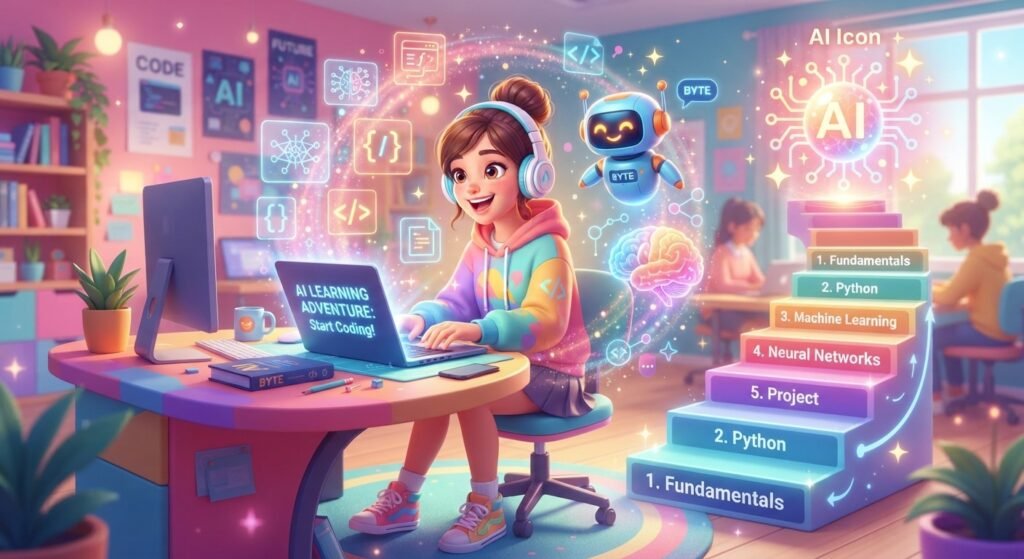
AI can feel confusing when you are just starting. If you want to know how to start learning AI, you do not need advanced mathematics or complicated coding on day one. A better approach is to learn the basics, understand how computers use data, and then practice with small projects. For students and teenagers, AI becomes easier when learning happens step by step. This guide explains what to learn first, how Python fits into AI, which concepts matter, how to choose beginner projects, and how to avoid common mistakes. By the end, you will have a simple roadmap for building useful AI skills without trying to learn everything at once.
What Should Beginners Learn First?
Artificial intelligence, or AI, is a broad field that helps computer systems perform tasks such as recognizing patterns, understanding language, making predictions, and generating content.
You do not need to learn every area immediately. Start with this simple map:
- AI: The larger field of intelligent computer systems.
- Machine learning: A method where systems learn patterns from data.
- Deep learning: Machine learning that uses multi-layer neural networks.
- Generative AI: Systems that can create text, images, audio, or code.
Step 1: Build Basic Computer and Math Skills
Before learning machine learning, be comfortable with basic computer tasks. You should know how to manage files, use a browser, install software, and work with simple programs.
Math matters too, but you do not need advanced formulas at the beginning. Start with percentages, averages, graphs, variables, and basic algebra. As you progress, you can study statistics, probability, and linear algebra.
Step 2: Learn Python for AI

Python is widely used for AI, data analysis, and machine learning. You do not need to become an expert programmer before exploring AI, but basic coding skills will make later topics much easier.
Start with:
- Variables and data types
- If and else statements
- Loops
- Functions
- Lists and dictionaries
- Basic file handling
Python’s official beginner resources provide guidance for people who are new to programming, along with tutorials and documentation. Python beginner resources.
Before moving to machine learning, write small programs. Try a calculator, number guessing game, or simple name organizer. These projects teach you how code behaves without adding too much complexity.
Step 3: Understand Data Before Machine Learning

Machine learning depends heavily on data. Therefore, understanding how data is organized is an important part of learning AI.
Imagine you want to predict whether a student might enjoy a type of game. You could have information such as genre, playing time, and previous ratings. A computer needs organized examples before it can find useful patterns.
Learn basic ideas such as:
- Rows and columns
- Features and labels
- Training and testing data
- Missing values
- Numerical and categorical data
- Basic data visualization
Later, you can explore tools such as NumPy and pandas. However, understand the problem first rather than rushing into libraries.
Step 4: Learn the Basics of Machine Learning
Once you understand beginner Python and data, start learning machine learning. Focus on what a model does instead of trying to memorize every algorithm.
A machine learning model finds patterns in examples and uses those patterns to make predictions or decisions. For example, a model can learn from examples to classify messages as spam or not spam.
Important concepts include:
- Supervised learning
- Unsupervised learning
- Classification
- Regression
- Training and testing
- Accuracy
- Overfitting
Google’s Machine Learning Crash Course includes lessons on regression, classification, data, neural networks, embeddings, and large language models. Its programming exercises can run in a browser through Colab. Google also lists Python, data, and basic math preparation as useful prerequisites. Google Machine Learning Crash Course
Step 5: Explore Generative AI
After learning the foundations, explore generative AI. This area includes systems that generate text, images, code, and other content.
Start by learning how prompts work, why AI responses can be inaccurate, and how to check generated information. For students, AI should support learning rather than replace thinking. It can explain difficult ideas or provide feedback while you remain responsible for your work.
You can also explore our guide to AI tutor tools for students for practical learning ideas.
Most importantly, remember that a confident AI answer is not automatically correct. Check important information before relying on it.
Step 6: Choose One AI Area to Explore
AI is too large to master as one subject. After learning the basics, choose one direction that interests you.
Machine Learning
Choose this path if you enjoy coding, data, and problem-solving. You can gradually learn algorithms, model evaluation, and data preparation.
Computer Vision
This area focuses on images and video. Beginner projects might involve simple image classification or object recognition.
Natural Language Processing
NLP focuses on human language. It can include text classification, translation, speech-related systems, and language models.
Generative AI
This path suits learners interested in chatbots, content generation, prompt design, or AI applications.
Step 7: Build Small AI Projects
Practice is where knowledge becomes useful. Instead of watching course after course, build small projects that match your current skill level.
Try ideas such as:
- A simple recommendation system
- A basic spam classifier
- A small chatbot
- A study-question generator
- A program that analyzes a small dataset
Start with a project that can be completed in a few days. When it works, improve one feature. Then write down what you learned, what failed, and how you fixed it.
If you want more practical ideas, our guide on smart ways teens can use AI connects AI with everyday student tasks.
Step 8: Learn to Check AI Results
Learning AI is also about evaluating results. A machine learning model can make incorrect predictions, while generative AI can produce information that sounds convincing but is wrong.
Practice asking:
- What data was used?
- How was the result tested?
- Could the data contain bias?
- What happens when the input changes?
- Is the result suitable for this task?
These questions build critical thinking and are useful whether you become an AI developer or simply use AI tools.
Common Mistakes Beginners Should Avoid
Many beginners make AI harder by trying to learn everything at once. Avoid jumping into advanced neural networks before learning basic programming and data concepts.
Also avoid watching tutorials without writing code, copying projects without understanding them, chasing every new AI tool, or trusting every AI-generated answer. Instead, choose one learning path and give yourself time.
If a topic feels too difficult, step back and strengthen the skill it depends on. Progress is more useful than rushing.
A Simple AI Learning Plan for Students
You can organize your learning into these stages:
- Learn basic computer and problem-solving skills.
- Learn beginner Python.
- Practice with simple data.
- Study basic machine learning concepts.
- Explore generative AI and responsible use.
- Choose one AI area.
- Build small projects.
- Improve your projects and document your learning.
Spend more time on a stage when necessary.
Why Learning AI Is Useful for Teens
AI learning can strengthen programming, problem-solving, data thinking, and critical evaluation skills. It can also support creative projects. For example, a student interested in web development might add an AI feature to a website, while another student could use data analysis to explore patterns.
You can also explore the benefits of ChatGPT for learning and everyday tasks.
The goal is to understand AI rather than simply collect a list of tools.
Frequently Asked Questions (FAQ)
1. Can I start learning AI without knowing Python?
Yes. You can learn basic AI concepts without coding. However, Python becomes useful when you want to build machine learning projects and work with data.
2. Is AI difficult for beginners?
Some topics are challenging, but beginners can make steady progress by learning one concept at a time. Strong basics make advanced topics easier.
3. What math do I need to learn AI?
Start with basic algebra, graphs, averages, and statistics. Later, you can study probability and linear algebra if your chosen path requires them.
4. Should teenagers learn AI?
Teenagers can explore AI through age-appropriate coding projects, data activities, and responsible use of AI tools. You do not need advanced knowledge to begin.
5. What programming language is useful for AI?
Python is a common starting point because it is widely used for programming, data work, and machine learning.
Conclusion
Learning AI does not require you to become an expert immediately. The best way to understand how to start learning AI is to build your skills in layers: computer basics, Python, data, machine learning, practical projects, and responsible AI use. Start small, practice regularly, and choose projects that genuinely interest you. Most importantly, stay curious. AI is a large field, so you can keep learning and specialize as your interests become clearer.