
AI Hallucination: What It Means and How to Spot One
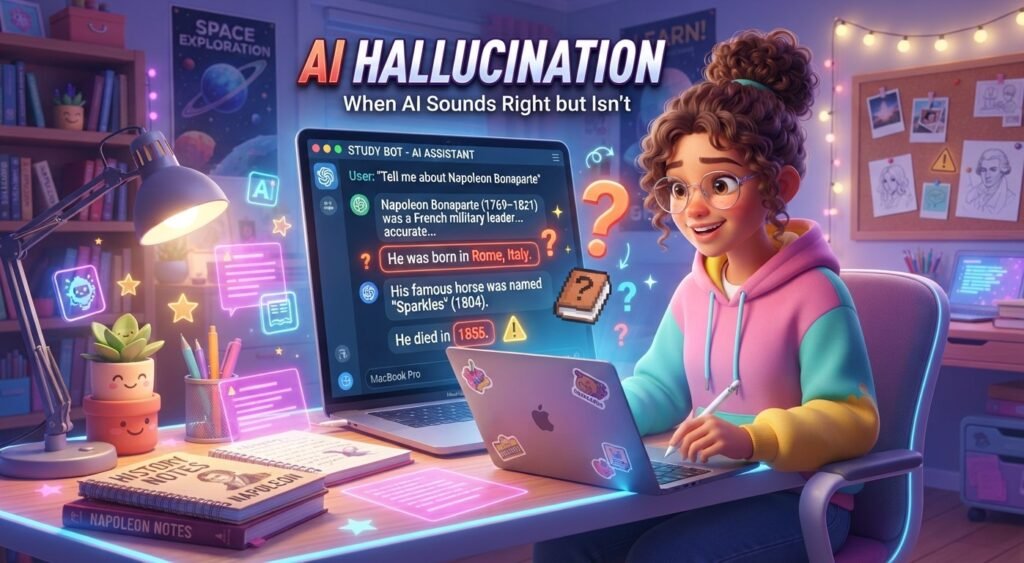
AI can be useful for homework, research, brainstorming, and everyday questions. However, an AI hallucination can make an answer look correct even when some information is false, incomplete, or made up. This can be confusing for students because AI tools often respond in a confident, natural way. A wrong date, invented source, incorrect explanation, or made-up fact may seem believable at first glance. The good news is that you can learn how to spot these mistakes before using AI-generated information. In this guide, you will learn what AI hallucinations are, why they happen, common examples, and simple ways students can check AI answers before trusting them.
What Is an AI Hallucination?
An AI hallucination happens when a generative AI system produces information that is inaccurate, unsupported, or completely made up, while presenting it as if it were a correct answer. NIST uses the term “confabulation” for confidently stated false or erroneous information, although “AI hallucination” is the term people commonly use.
For example, an AI tool might create a realistic-looking book title, website, study fact, or source that does not actually exist. The answer may sound confident and well-written, but that does not mean it is true. This is why AI can be useful for explaining ideas and helping with schoolwork, but important information should still be checked against reliable sources.
Why Do AI Hallucinations Happen?
Generative AI systems produce likely sequences based on patterns learned from data. They are not simply looking up every answer in a perfect database. Because of this, a model can sometimes create an answer that sounds reasonable without reliable evidence behind it.
Several situations can make errors more likely.
Unclear Questions
A vague prompt can leave an AI system with too much room to guess. For example, “Tell me about Java” could refer to the programming language or the Indonesian island. A more specific prompt gives the system clearer context.
Rare or Changing Information
AI may struggle with obscure people, niche subjects, old documents, or information that has changed recently. When reliable information is limited, answers may become less dependable.
Questions With False Assumptions
If a prompt assumes something is true, an AI may sometimes follow the assumption instead of challenging it. This can produce an answer that sounds logical but is based on a false starting point.
Exact Facts
Dates, statistics, names, quotations, and citations need extra care. A small mistake can change the meaning of an answer.
What Does an AI Hallucination Look Like?
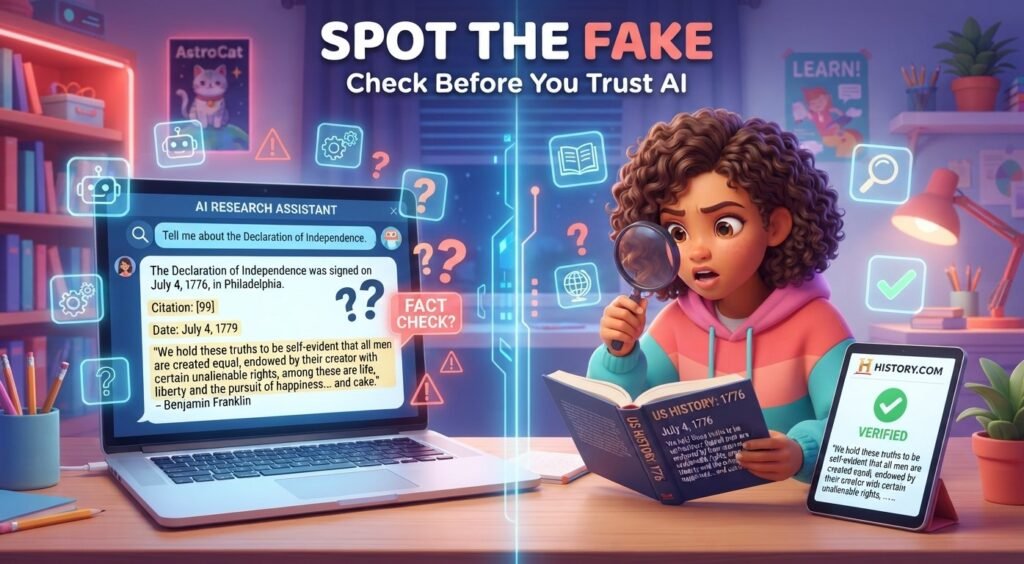
AI hallucinations are not always obvious. They can appear as:
- A fake book, person, website, or research paper
- An incorrect date or historical event
- A made-up quotation or statistic
- A citation that does not support the claim
- A wrong explanation of a technical concept
- A confident answer to a question with missing information
- A mixture of real facts and invented details
One tricky problem is that an answer can contain several correct facts and one false claim. That makes the error harder to notice. For example, an AI tool might correctly explain Python but give an incorrect claim about a particular Python feature.
Why Are AI Hallucinations a Problem for Students?
Students often use AI to understand lessons, brainstorm ideas, summarize information, or get help with difficult topics. These uses can be helpful, but an incorrect answer can cause problems if it is copied without checking.
A student might include an invented source in an assignment or study an incorrect definition before a test. The key issue is not simply that AI made a mistake. The bigger problem is trusting the mistake without verification.
If you use AI as a learning assistant, think of its answer as a starting point rather than automatic proof.
For ideas about using AI for learning, you can also explore how an AI tutor can help students learn.
How Can You Spot an AI Hallucination?
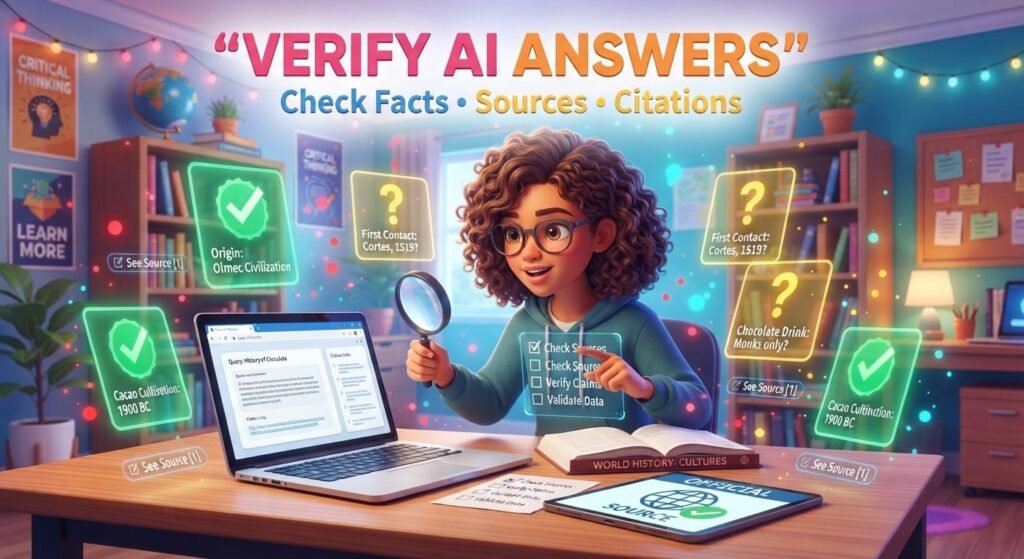
You do not need to be an AI expert to check an answer. A few simple habits can make a big difference.
1. Check Important Facts
Look up important names, dates, numbers, definitions, and claims using reliable sources. If an answer affects your schoolwork, do not rely on one AI response alone.
2. Open the Sources
If an AI response gives you links or references, open them. Check whether the source exists and whether it actually supports the statement.
A citation can look professional while still being incorrect. NIST notes that generative AI can produce confabulated citations that appear to justify an answer.
3. Ask About Uncertainty
You can ask, “What source supports this?” or “Which part of this answer needs verification?” This may help identify information that deserves closer checking.
However, the AI’s explanation is not proof that the original answer is correct. The actual source matters more.
4. Compare With Trusted Sources
For school research, compare important claims with textbooks, school resources, university pages, official documentation, or government websites.
For example, when learning about AI risks and responsible use, you can review NIST’s AI guidance for authoritative information.
5. Watch for Suspicious Details
Be careful when an answer gives very precise information that you cannot verify. A detailed answer is not automatically a reliable answer.
How Can Students Reduce AI Hallucinations?
You cannot guarantee that an AI system will never make a mistake. However, you can improve your workflow.
Write Clear Prompts
Give the AI enough context about what you need. Instead of “Explain AI,” try “Explain AI hallucinations to a Grade 8 student using one simple example.”
Ask It to Flag Uncertainty
Tell the AI to identify information it is unsure about. You can ask it to separate information that is supported from claims that need verification.
Still, an AI saying it is confident or uncertain does not prove the answer is correct.
Break Big Questions Into Smaller Ones
For complicated research, ask smaller questions and check important answers along the way. This makes errors easier to identify.
Provide Reliable Source Material
When a tool supports it, give the AI a trusted document to work from. This can keep the response focused on that material, although you should still check whether the summary is accurate.
AI Hallucination vs. a Normal Mistake
An ordinary mistake can happen when a person misunderstands a fact, remembers something incorrectly, or makes a calculation error. An AI hallucination is different because a system can generate a convincing answer without knowing that the information is false.
Therefore, confidence and accuracy should be treated as separate things. A confident tone does not prove that an answer is correct.
Can AI Hallucinations Be Completely Stopped?
AI systems can be improved through evaluation, better data, grounding, and other techniques, but users should not assume that every generated answer will be error-free. NIST’s GenAI evaluation work tests the capabilities and limitations of generative AI systems.
Google has also described hallucination as a challenge in generative AI and has researched ways to ground AI outputs in real-world information. Google’s research on AI hallucinations
Reducing errors is not the same as eliminating them. For students, verification should remain part of a normal AI workflow.
Smart AI Habits for Students
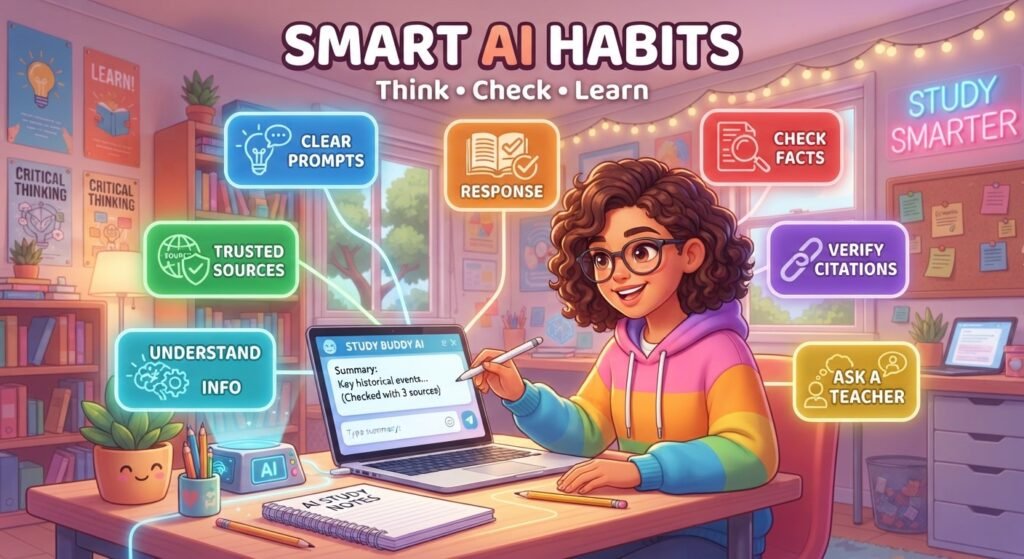
Use this simple checklist:
- Ask a clear question.
- Read the whole response instead of copying it immediately.
- Identify claims that matter.
- Check important facts with trusted sources.
- Open and verify citations.
- Put the information into your own understanding.
- Ask a teacher when a topic remains unclear.
You can also explore AI for teens for more practical ideas about using AI responsibly.
Frequently Asked Questions (FAQ)
1. What is an AI hallucination?
It is inaccurate, unsupported, or invented information generated by an AI system and presented as though it were valid.
2. Why does AI hallucinate?
Generative AI creates responses from learned patterns, so it can sometimes produce plausible information that is not factually correct.
3. Can students trust AI for homework?
Students can use AI as a learning aid, but important facts, sources, calculations, and explanations should be checked before being used in schoolwork.
4. How can I check an AI answer?
Check important claims against reliable sources, open citations, compare information from trusted sources, and ask a teacher when necessary.
5. Can AI hallucinations be prevented?
They can be reduced through model improvements, evaluation, reliable source material, and careful prompting, but users should still verify important information.
6. Are AI hallucinations always easy to spot?
No. Some incorrect answers look polished and may contain a mixture of accurate and invented information, which makes verification important.
Conclusion
An AI hallucination can turn a convincing answer into a misleading one, but students can reduce the risk by building good verification habits. Use AI to learn, brainstorm, and explore ideas, while checking important claims against reliable sources. Most importantly, remember that confident wording is not the same as factual accuracy. When you pause, verify, and think critically, AI becomes a more useful learning assistant rather than something you have to trust blindly.