
Roadmap To Learn AI

Artificial intelligence is becoming an important part of everyday life, from search engines and chatbots to learning tools and smart apps. For beginners, finding the right roadmap to learn AI can make the learning process much easier and less confusing.
This guide explains what AI is, which skills you need, how to start learning AI step by step, and which free resources and tools can help you practice.
What Is Artificial Intelligence?

Simple Meaning of Artificial Intelligence
Artificial intelligence, or AI, is technology that allows computers to learn from information, recognize patterns, and perform tasks that normally require human intelligence.
AI can answer questions, translate languages, recognize images, recommend content, and help people make decisions. It is already used in education, healthcare, entertainment, business, and many everyday apps.
Examples of AI in Everyday Life 3
AI may already be a part of your everyday life. Chatbots such as ChatGPT can answer questions and support learning, while YouTube and Netflix use AI to recommend content.
Voice assistants, navigation apps, online shopping recommendations, and smart search systems also use AI to make digital experiences more useful and personalized.
Why More Students Want to Learn AI
Growing Use of AI
Artificial intelligence is becoming an important part of modern life. Students can find AI in education platforms, writing tools, design software, search engines, and social media.
Learning about AI can also help students explore programming, data, automation, and machine learning. These skills can open doors to exciting technology careers and help students prepare for the future.
Benefits of Learning AI Early
Learning AI early can improve problem solving, logical thinking, creativity, and digital skills. It also helps students understand how many of the technologies they use every day actually work.
You do not need to become an AI expert immediately. Building a basic understanding now can make advanced topics easier to learn later.
Can Beginners Learn AI at Home?
Do You Need Coding Skills?3
No. Beginners can start learning AI without advanced programming knowledge. You can first understand basic AI concepts through videos, examples, and beginner-friendly tools.
Basic Python becomes useful when you want to build AI projects or move into technical areas. Beginner courses such as AI for Everyone can also introduce AI concepts without requiring deep technical knowledge.
Is Artificial Intelligence Difficult to Learn?
AI can look complicated because it includes concepts such as data, machine learning, and automation. However, learning these topics one step at a time makes them much easier to understand.
Start with basic concepts, then gradually move toward Python, machine learning, and practical projects. You do not need to understand everything at once.
Skills You Need Before Learning AI
Basic Python Knowledge
Python is one of the most popular programming languages for artificial intelligence because its syntax is beginner-friendly and it has many libraries for machine learning and data science.
You do not need advanced Python at the beginning. Start with variables, conditions, loops, functions, and basic data structures.
Understanding Math Basics
Basic math can help you understand how AI works with numbers, data, and predictions. Statistics and probability become more important as you move into machine learning.
However, you do not need advanced mathematics to begin. Start with basic formulas, patterns, and logical thinking.
Problem Solving and Curiosity
Curiosity is an important part of learning AI. Asking questions and experimenting with new ideas helps you understand unfamiliar concepts.
Problem solving is equally important because AI often involves breaking a large problem into smaller steps.
Step-by-Step Roadmap to Learn AI
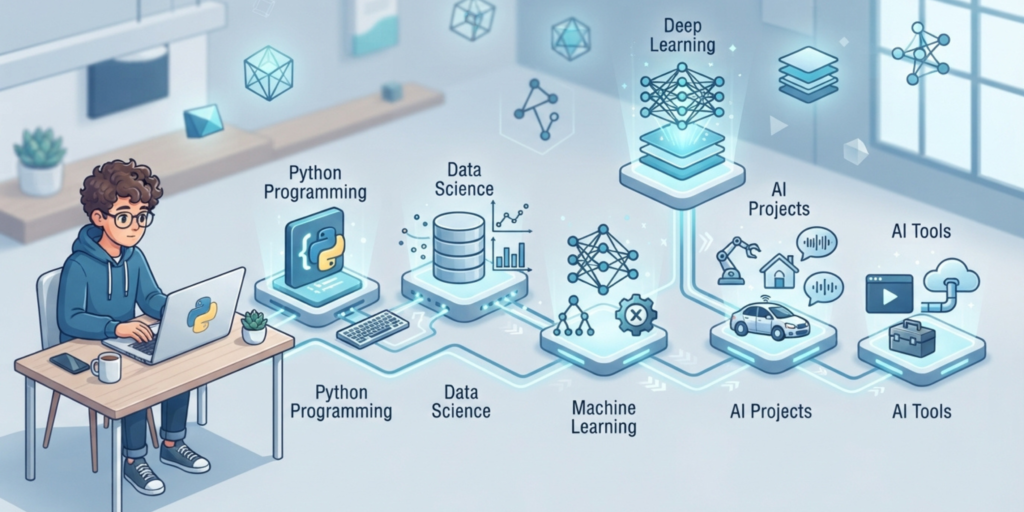
Step 1: Learn Python Programming
Start with basic Python programming. Learn variables, loops, conditions, functions, and simple data structures.
Practice with small coding exercises instead of only watching tutorials. This will give you a foundation for working with AI and data later.
Step 2: Understand Machine Learning Basics
Machine learning is a part of artificial intelligence where computers learn patterns from data.
Start by understanding simple ideas such as supervised and unsupervised learning. For example, a supervised model can learn to identify spam emails from labeled examples, while an unsupervised system can find groups or patterns in unlabeled data.
Step 3: Learn Data Science Fundamentals
AI systems depend heavily on data. Learning how to collect, clean, organize, and analyze data helps you understand what happens before an AI model produces a result.
Basic data skills also make machine learning concepts easier to understand.
Step 4: Explore Deep Learning
Deep learning is an advanced area of AI that uses neural networks to process large amounts of information.
It is used for tasks such as image recognition, speech processing, and language understanding. Beginners do not need to master deep learning immediately. Understanding what neural networks do is a good starting point.
Step 5: Practice With Small AI Projects
Projects turn theory into practical skills. Beginners can try simple projects such as a basic chatbot, recommendation system, prediction model, or data analysis project.
Start small. A simple finished project is more useful for learning than a complicated project you cannot complete.
Step 6: Use AI Tools for Practice
Modern AI tools can make learning more interactive. ChatGPT and Google Gemini can help explain concepts and generate practice ideas.
Google Colab allows you to run Python code online, while Kaggle provides datasets, exercises, and learning resources for practicing data science and machine learning.
Use these tools as learning assistants, but make sure you understand the concepts yourself.

Best Free Resources to Learn AI
Free AI Courses
Platforms such as Coursera, edX, and Google offer beginner-friendly courses covering artificial intelligence, machine learning, and related topics.
A structured course can make learning easier because you follow a clear sequence instead of jumping randomly between topics.
YouTube Tutorials
YouTube is useful for visual learning. Channels such as freeCodeCamp and other beginner-focused programming creators offer tutorials on Python, data science, and AI.
Choose one learning path and follow it consistently instead of watching unrelated videos every day.
Beginner-Friendly AI Books
Books can provide a deeper understanding of AI concepts. Resources such as Artificial Intelligence: A Guide for Thinking Humans and Hands-On Machine Learning can support your learning as you become more comfortable with the subject.
You do not need to read several books at once. Choose one that matches your current skill level.
Common Mistakes Beginners Should Avoid
Learning Too Many Topics Together
AI is a huge field, so trying to learn Python, machine learning, deep learning, robotics, and data science at the same time can quickly become overwhelming.
Focus on one stage at a time. Build your foundation before moving to advanced topics.
Skipping Practice
AI tools are useful for explanations and practice, but they should not replace learning the fundamentals.
Try to understand why a solution works instead of simply copying an answer generated by an AI tool. This builds stronger and more reliable skills.
Depending Only on AI Tools
Reading about AI is not enough. You need to practice what you learn through coding exercises, datasets, and small projects.
Platforms such as Kaggle can help beginners practice machine learning and data skills.
How Long Does It Take to Learn AI?
Learning AI as a Beginner
The time required depends on your goals and consistency. With regular study, beginners can understand basic AI concepts within a few weeks.
Building enough knowledge to create small projects usually takes a few months of steady practice. The goal should be consistent progress rather than learning everything quickly.
Learning AI for a Career
A career in AI requires deeper knowledge of programming, data science, machine learning, and eventually areas such as deep learning.
It also requires practical experience. Building projects and working with real datasets can help turn theoretical knowledge into useful skills.
Career Opportunities After Learning AI

AI Engineer
AI engineers develop applications that use artificial intelligence. They may work on chatbots, recommendation systems, automation, and other intelligent software.
Machine Learning Engineer
Machine learning engineers build and improve models that learn from data and make predictions. Their work is used in areas such as search, recommendations, and fraud detection.
Data Scientist
Data scientists analyze data to find patterns and useful insights. They use statistics, programming, and problem solving to help organizations make better decisions.
AI Content and Automation Roles
AI tools are also creating opportunities in content, research, workflow automation, and productivity. These roles often combine AI tools with skills from writing, marketing, design, or business.
Tips to Stay Consistent While Learning AI
Build Small Daily Habits
You do not need to study for hours every day. Even short, regular learning sessions can help you make steady progress.
Choose one topic at a time and set a realistic routine that you can actually maintain.
Practice With Real Projects
Projects keep learning practical and interesting. Try building small applications, analyzing datasets, or creating simple machine learning experiments.
Each completed project helps you understand how different AI concepts connect.
Frequently Asked Questions
Can I learn AI without coding?
Yes. You can learn basic AI concepts without coding. However, learning Python is highly useful if you eventually want to build AI projects or pursue technical AI roles.
Which programming language is best for AI?
Python is one of the most popular choices for artificial intelligence because it is beginner-friendly and has extensive libraries for machine learning and data science.
Is Python necessary for AI?
Python is not necessary for understanding basic AI concepts, but it is strongly recommended for practical AI development and machine learning.
How long does it take to learn AI from scratch?
Beginners can understand basic AI concepts in a few weeks with regular study. Developing stronger practical skills and building projects generally takes several months.
What are the best free AI tools for beginners?
ChatGPT, Google Gemini, Kaggle, and Google Colab are useful tools for learning, practicing, and exploring artificial intelligence.
Can students learn AI at home?
Yes. Students can learn AI at home through online courses, tutorials, coding exercises, and practical projects. A consistent learning routine is more important than having expensive equipment.

Conclusion
Learning AI does not have to feel overwhelming. Start with the basics, learn Python, understand machine learning and data, and gradually move toward practical projects.
Use free resources and AI tools to support your learning, but focus on understanding the fundamentals instead of simply copying answers.
You do not need to master everything at once. Start small, practice regularly, and build your skills step by step. With a clear roadmap to learn AI, patience, and regular practice, AI can become a useful and exciting technology skill for your future.